Best Enzyme Cleaner for Vomit Stains and Smell
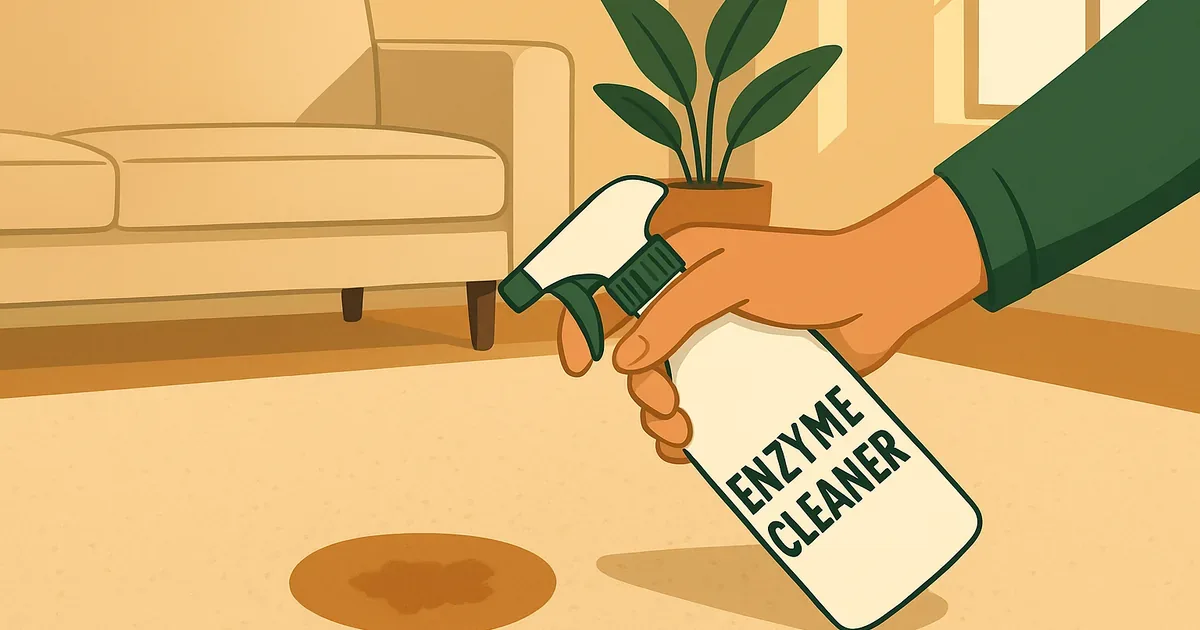
Table of Contents
Vomit is one of the hardest stains for enzyme cleaners because it contains proteins, fats, and acids all at once. A basic enzyme cleaner with only protease handles the protein but leaves greasy residue and lingering smell. You need a product with both protease and lipase enzymes. And you need to handle the first 60 seconds correctly before you even reach for the cleaner.
This guide covers the emergency cleanup steps, why vomit chemistry matters for choosing a cleaner, which features to look for in a product, and surface-specific instructions. If you want to understand how enzyme cleaners work, that guide covers the basics.
Emergency cleanup protocol (before the enzyme cleaner)
These first steps happen before you grab the enzyme cleaner. Getting the bulk material off the surface quickly prevents the stain from spreading and the acid from damaging fibers.
-
Cover the vomit with baking soda or paper towels to contain it and reduce the smell. A thick layer of baking soda absorbs moisture and makes the next step easier.
-
Wait 5-10 minutes for the baking soda to absorb moisture. This turns liquid into a semi-solid that’s much simpler to pick up.
-
Scoop the solids with a dustpan, spatula, or stiff cardboard. Scrape toward the center, not outward. Moving outward spreads the stain into clean carpet.
-
Blot (don’t rub) remaining moisture with paper towels. Press straight down and lift. Rubbing pushes vomit deeper into the fibers.
-
Now apply the enzyme cleaner to the residual stain and odor. The bulk is gone, and the cleaner can focus on breaking down what’s left in the fibers.
💡 Keep a Vomit Cleanup Kit Ready
If you have pets or young kids, put together a cleanup kit: baking soda, paper towels, a dustpan, and enzyme cleaner in a bucket under the sink. You’ll thank yourself at 2 AM when a sick pet or child makes a mess and you don’t have to search for supplies in the dark.
Why vomit is different from other stains
Most enzyme cleaners are designed for urine, which is mostly water and urea. Vomit is a different beast. It contains four components, and each one needs different treatment.
- Proteins (from partially digested food): broken down by protease enzymes
- Fats and oils (from food and bile): broken down by lipase enzymes
- Acids (stomach acid, pH 1.5-3.5): can damage carpet fibers and hard surfaces if not cleaned quickly. The NCBI enzyme reference explains how different enzyme types target different substrates
- Bile pigments (the yellow or green color): protein-based, broken down by protease
Here’s the problem: most general-purpose enzyme cleaners contain only protease. They handle the protein portion well but leave the fat behind. That greasy residue traps odor molecules in the carpet fibers. So you end up with a stain that looks cleaner but still smells.
The fix is simple. Look for an enzyme cleaner that lists both protease and lipase on the label. Lipase targets the fat content that protease can’t touch.
ℹ️ Check for Lipase on the Label
Lipase is the enzyme that breaks down fats. If your enzyme cleaner doesn’t list lipase as an active ingredient, it’s not built for vomit cleanup. You’ll get partial results at best. Check the ingredient list before you buy.
Vomit Components and Required Enzymes
| Component | Enzyme Needed | Notes |
|---|---|---|
| Proteins (food particles) | Protease | Most common enzyme in cleaners |
| Fats/oils | Lipase | Often missing from basic formulas |
| Stomach acids | Neutralized by enzymes | pH normalizes during cleanup |
| Bile pigments | Protease | Protein-based yellow/green color |
What to look for in an enzyme cleaner for vomit
This isn’t a product roundup, but here’s what to check when choosing a product for vomit cleanup.
Features that matter for vomit:
- Contains both protease and lipase (both are required for full breakdown)
- Works on soft surfaces (carpet, upholstery, fabric)
- Available in an unscented formula (vomit plus perfume creates a worse smell)
- Concentrated enough to saturate carpet fibers
- Listed on the EPA Safer Choice program (a good sign the formula meets federal safety standards)
For specific product picks, check our best enzyme carpet cleaners list. If pet vomit is your main concern, our enzyme cleaners for pet odors guide covers products that handle both stain and smell.
⚠️ Don't Use Bleach or Peroxide First
Don’t use bleach or hydrogen peroxide on vomit stains before using enzyme cleaner. These chemicals can set the protein stain (similar to cooking an egg) and deactivate the enzymes. Clean with enzyme cleaner first. Only use other products after the enzyme treatment is complete.
Surface-by-surface vomit cleanup
The enzyme cleaner does the same job on every surface. But the application method changes depending on what you’re cleaning.
Carpet
Carpet is the most common landing zone for vomit, and the trickiest to clean because liquid soaks past the fibers into the pad.
After completing the emergency cleanup steps above:
- Saturate the stained area with enzyme cleaner (pour, don’t just spray)
- Cover with plastic wrap to keep the enzymes wet and active
- Wait 4-8 hours (vomit stains need longer contact time than urine)
- Remove the cover, blot dry with clean cloths
- Vacuum the area once fully dry
- Old vomit stains may need a second treatment
For more detail on carpet technique, see our removing biological stains with enzyme cleaners guide. The application method is the same.
Upholstery and fabric
Couches, chairs, and car seats need a lighter touch than carpet. Too much liquid soaks into foam padding and takes days to dry.
- Check the care tag first (look for “W” which means water-based cleaners are safe)
- Apply enzyme cleaner with a cloth, don’t pour it directly on cushions
- Use less liquid than you would on carpet
- Place a fan pointed at the treated area to speed drying
- For removable cushion covers, treat the cover and the foam separately
Hard floors (tile, vinyl, hardwood)
Hard floors are easier because the stain sits on the surface rather than soaking in.
- Scoop solids, wipe the area, spray enzyme cleaner
- Wait 15-30 minutes
- Wipe clean with a damp cloth
For hardwood, use minimal liquid and wipe up quickly. Don’t let enzyme cleaner pool on wood surfaces. The National Wood Flooring Association recommends damp cleaning over wet cleaning for all hardwood. For tile, apply cleaner directly into grout lines since grout is porous and traps odor.
Mattress
Mattresses need careful treatment to avoid deep soaking that leads to mold.
- Blot immediately to prevent the vomit from soaking deep
- Apply enzyme cleaner lightly with a spray bottle (don’t pour)
- Cover with plastic wrap and wait 8-12 hours
- Point a fan at the treated area and let it dry fully before putting sheets back on
For full mattress instructions, check our guide on cleaning a mattress with enzyme cleaner.
Emergency Vomit Cleanup Protocol
Remove solids
Scrape up solid matter with a flat tool or cardboard. Work from edges inward.
Blot the area
Press clean cloths into the stain to absorb liquid. Don't rub.
Apply enzyme cleaner
Saturate with a formula containing both protease and lipase.
Cover and wait
Lay plastic wrap over the area. Wait 4-8 hours for fresh stains, 8-12 for set-in.
Blot dry and inspect
Remove plastic, blot excess. If odor remains, re-treat with deeper saturation.
Getting rid of the smell (when the stain is gone but the odor stays)
Sometimes the visible stain disappears but the smell lingers. This usually means fat residue and bile are still trapped in the carpet fibers or padding.
Here’s how to fix it:
- Re-treat with enzyme cleaner, focusing on saturation depth. The first treatment may not have reached all the residue in the carpet pad.
- Cover and wait longer this time. Give it a full 8-12 hours under plastic wrap.
- Sprinkle baking soda over the area after the enzyme treatment dries. Baking soda absorbs remaining odor molecules. Leave it for a few hours, then vacuum.
- Open windows for ventilation during and after treatment. Fresh air helps clear lingering smells faster.
If the smell persists after two full enzyme treatments, the vomit may have reached the carpet pad or subfloor. At that point, you may need to pull back the carpet corner and treat the pad directly, or call a professional carpet cleaner.
ℹ️ Baking Soda After, Not Before
Use baking soda to absorb moisture during the initial cleanup. But don’t leave baking soda on the stain when you apply enzyme cleaner. Baking soda is alkaline and can interfere with enzyme activity. Apply baking soda only after the enzyme treatment is done and the area has dried.
Wrapping up
Vomit stains fail with regular enzyme cleaners because those products only handle half the problem. The protein breaks down, but the fat stays. That fat traps odor, and you’re left wondering why the carpet still smells.
The solution: use an enzyme cleaner with both protease and lipase. Follow the emergency protocol to remove the bulk material first. Then give the enzymes enough contact time to break down everything that’s left. For carpet, that means covering the area and waiting 4-8 hours minimum.
Keep a cleanup kit under the sink if you have pets or kids. Being able to respond in the first minute makes the difference between a one-treatment cleanup and a multi-day project. For safety considerations around children and pets, see our enzyme cleaner safety guide. If contact time confuses you, our breakdown of how long enzyme cleaners take to work has a full timing table. And for more on the science behind different enzyme types, check our guide to proteases, lipases, and amylases.
Frequently Asked Questions
Will enzyme cleaner remove old vomit stains from carpet?
Why does my carpet still smell like vomit after cleaning?
Can I use enzyme cleaner for cat vomit on hardwood floors?
Is enzyme cleaner safe to use after a child vomits on the carpet?
Do I need a special enzyme cleaner for vomit, or will any enzyme cleaner work?
Related Articles
Is OdoBan an Enzyme Cleaner? What the EPA Label Says
No. OdoBan's active ingredient is a quaternary ammonium compound, not an enzyme. We read the EPA label to see what it does and where it applies.
How to Disinfect Carpet: What Actually Works
Most disinfectants are only registered for hard surfaces, so carpet is a different job. Here's what cleaning, sanitizing, and disinfecting really mean.
Cleaning Product Researcher
Sarah Chen is a pen name for our lead product researcher. A lifelong dog person who now shares her home with two cats, she's no stranger to enzyme cleaners. She writes the guides and reviews on this site based on product research, ingredient analysis, and real user feedback.